
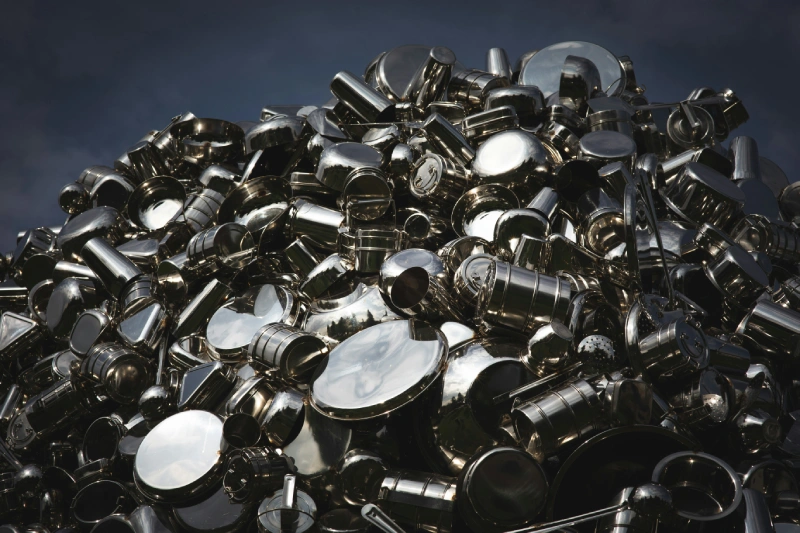
In 2024, global stainless steel production reached approximately 60 million metric tons, accounting for about 3% of total steel output worldwide. Stainless steel is 100% recyclable, and recycled scrap makes up over 40% of global production input, reducing demand for raw materials and minimizing environmental impact
Major Producers
•China dominates global production, contributing roughly 60% of total output.
•Other significant producers include India, Japan, Indonesia, and countries in the European Union.
Common Grades
•Grade 304: Contains about 18% chromium (Cr) and 8% nickel (Ni). It offers excellent corrosion resistance, good formability, and is widely used in kitchen equipment, chemical containers, and architectural applications.
•Grade 316: Contains about 18% Cr, 10% Ni, and 2% molybdenum (Mo). The addition of Mo improves resistance to chlorides and harsh environments, making it the material of choice for marine, medical, and chemical processing applications.
Physical Properties
•Melting point: ~1400–1450 °C (2550–2650 °F).
•Non-magnetic in the annealed state (especially grades like 304 and 316).
Applications
Stainless steel is valued for its durability, hygiene, and resistance to corrosion and oxidation. Major application sectors include:
•Construction & infrastructure (bridges, cladding, structural supports)
•Transportation (automotive exhausts, shipbuilding, aerospace components)
•Energy & industry (oil, gas, chemical processing equipment)
•Consumer goods (appliances, cookware, medical instruments)
